Root Canal Treatment

Save the tooth. Stop the pain. Fewer visits than you’d expect.

“Root canal” has a reputation it no longer deserves. Today it is a calm, well-managed procedure — and the real risk isn’t the treatment, it’s putting it off. At Bellevue Dental we combine in-house 3D imaging, an in-house root canal expert and same-day crowns so a painful tooth can be diagnosed, treated and protected with as little disruption as possible.

Book a consultationIn pain? Contact us today
Symptoms

When a tooth needs root canal treatment

Root canal treatment is needed when the pulp — the living tissue inside the tooth — becomes inflamed or infected, usually because of deep decay, a crack or an old filling that has failed. The signs don’t always arrive together, and some people feel almost no pain while an infection quietly progresses. If you notice any combination of these, have it assessed promptly.

Pain that painkillers won’t fix

A throbbing ache that arrives without an obvious cause, worsens when you bite down, and wakes you at night. Paracetamol or ibuprofen may take the edge off briefly, but the pain keeps coming back — a reliable sign the nerve is inflamed or infected rather than simply sensitive.

Sensitivity that lingers

Ordinary sensitivity settles within a few seconds of removing the hot or cold trigger. Nerve-related pain lingers. If discomfort persists well beyond the initial sensation instead of fading quickly, that’s the pulp signalling something has gone wrong.

Swelling, darkening or a bad taste

A small raised bump on the gum near the tooth (a sinus tract) means infection is trying to drain. A tooth that has gradually darkened compared with its neighbours, or a sour taste that keeps returning even after brushing, can point to the same cause.

Why acting quickly protects the tooth

A pulp infection won’t resolve on its own. Left untreated it spreads — first to an abscess, then potentially into the surrounding bone — and at that stage extraction often becomes the only option, meaning an implant or bridge instead of your own tooth. Caught early, root canal treatment is a simpler procedure, costs less overall, usually needs fewer appointments, and gives you a tooth that can last for decades with the right restoration.

Step by Step

What the procedure actually involves

Most of the anxiety around root canals comes from expecting sharp pain. With modern anaesthesia you’ll feel pressure during treatment, but not pain. Here is what happens at each stage.

1

Getting you numb and comfortable

Treatment starts with local anaesthetic. Once the tooth is fully numb we place a rubber dam — a thin sheet that isolates the tooth, keeping the area clean and dry for infection control and precision. If you are particularly anxious, talk to us at your consultation about the options available to make the appointment easier.

2

Cleaning out the infected pulp

A small opening is made through the top of the tooth to reach the pulp chamber. The inflamed or infected tissue is removed and the root canals are carefully shaped using flexible nickel-titanium rotary instruments — faster and more precise than older hand-filing. The canals are then irrigated with antibacterial solutions to eliminate remaining bacteria and debris.

3

Sealing the canals

Once cleaned and shaped, the canals are dried and filled with a biocompatible material called gutta-percha, then sealed. This closes off the root system so bacteria cannot re-enter.

4

Protecting the tooth with a crown

A tooth without a living pulp is more brittle, so most root-treated teeth need a crown to protect them from fracture. A well-fitted crown is what gives the tooth the strength to function normally for years — and at Bellevue we can often design, mill and fit it on the same day (see below).

Diagnosis

Why we look before we treat

A standard dental X-ray produces a flat, two-dimensional image. It’s useful, but it compresses the whole root system into one plane — so curved canals, hidden extra roots and the true extent of an infection can all be missed. Cone beam CT (CBCT) produces a full three-dimensional map of the tooth and surrounding bone, showing exactly how many canals there are, how they curve, whether any cracks exist and how far infection has spread.

In endodontic research, missed canals consistently emerge as one of the most common reasons root canal treatment fails. A treatment plan built on 3D imaging and expert input is built on a complete, accurate picture — and that thoroughness at the diagnostic stage is what underpins long-term success.
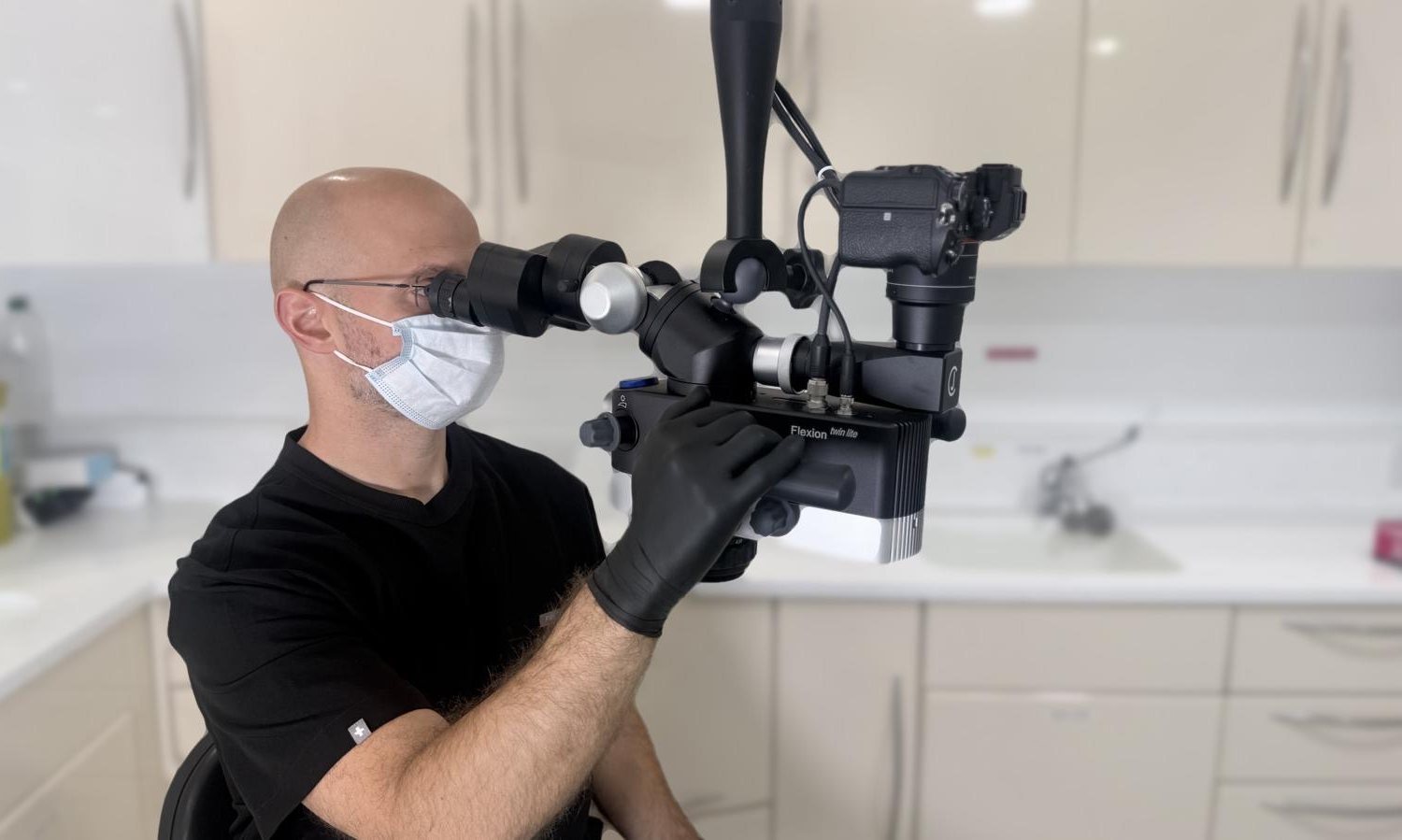
Dr Spencer Richman performing root canal treatment under a dental operating microscope

In-house CBCT imaging

We take 3D scans at the practice, at the same appointment — no referral to a separate imaging centre before treatment can begin. The full clinical picture is available from the outset.

Dr Spencer Richman, root canal expert at Bellevue Dental, Wandsworth Common

In-house root canal expert

For straightforward cases a well-trained general dentist is entirely appropriate. For complex cases — molars with multiple curved canals, previous root canals that need retreating, calcified canals, or an uncertain diagnosis — a root canal expert is the right choice. Our in-house expert, Dr Spencer Richman, is a root canal expert who treats precisely these cases at Bellevue, so you don’t need to travel across London for expert-level care.

About Dr Richman →
Root to Crown

Same-day treatment for cracked and painful teeth

A cracked tooth is time-sensitive in a way many patients don’t realise. Every bite applies force across the crack, and the deeper it extends, the harder the tooth becomes to save. Delay often turns what could have been a root canal and crown into an extraction. That’s why, where the case allows, we treat the whole problem in one visit — from diagnosis through to fitting the final crown.

Crowns milled in-house

Traditionally the crown stage means an impression, two to three weeks’ wait for a laboratory, and a temporary crown in the meantime. With our in-house CAD/CAM milling, the crown is designed digitally, milled at the practice and fitted at the same appointment. You leave with a permanent, colour-matched restoration.

One appointment, not three

No repeated time off work. No temporary crown to manage. No window where the tooth sits vulnerable while you wait for the lab. For anyone who can’t easily take multiple mid-week days away, consolidating treatment into a single visit makes a measurable difference.

Urgent cases seen quickly

If you’re in pain we aim to see you promptly rather than asking you to wait weeks for the next available slot. Contact the practice directly and tell us what’s happening — the sooner the tooth is assessed, the more options you have.

Aftercare

What to expect after treatment

The first 48 hours

Mild soreness and sensitivity around the treated tooth for one to three days is completely normal — the surrounding tissues have been working during treatment and need a short period to settle. Over-the-counter ibuprofen or paracetamol manages this well for most people. Stick to soft foods for the first couple of days, avoid chewing on the treated side, and skip anything very hot, very cold or crunchy until sensitivity has eased. Avoid smoking during healing, as it slows recovery.

When to call us

Swelling that worsens rather than improves after the first day or two, severe pain that standard pain relief isn’t touching, or a fever are all reasons to contact the practice promptly. These situations are uncommon, but they are not something to wait out — get in touch and we’ll see you.

Keeping the tooth healthy long-term

A root-treated tooth with a well-fitted crown can last for decades. The essentials apply: brush twice daily, clean between the teeth with interdental brushes or floss, and keep up with your check-ups and hygiene visits. Because the same team monitors the tooth at every follow-up, any change is caught early by clinicians who know its history.

Fees

Expert-led root canal treatment from £1,200

Every case is different, so we confirm the exact fee in writing after your consultation and 3D scan — before any treatment begins. The figures here are guide prices for expert-led endodontic care at Bellevue. Finance options are available on treatment over £250; see our full fees page for details.

Endodontic consultation£150
Investigation with 3D CBCT scan£250
Root canal treatment (expert-led)from £1,200
Complex cases & retreatmentfrom £1,250
Surgical root canal treatmentfrom £1,300
Same-day CEREC crownfrom £1,250
Common Questions

Root canal treatment, answered

Is root canal treatment painful?+

With modern local anaesthesia, the procedure itself should not be painful. You may feel pressure, but not sharp discomfort. Some mild soreness in the days after treatment is normal and manageable with over-the-counter pain relief. In fact, most patients feel dramatically better once the infected pulp has been removed.

How much does a root canal cost at Bellevue?+

Expert-led root canal treatment starts from £1,200, with complex cases and retreatments from £1,250. Most root-treated teeth also need a crown to protect them, from £1,250. We give you a written estimate after your consultation and scan, and finance is available. Full details are on our fees page.

Can I have my root canal and crown done in the same appointment?+

In many cases, yes. With our in-house CEREC milling, the crown can be designed, milled and fitted at the same appointment as the root canal treatment. Ask the team whether this approach suits your specific case.

When would I see the root canal expert?+

Expert care is appropriate for complex cases: molars with multiple curved canals, retreatment after a previous root canal, calcified canals, or where the diagnosis is uncertain. Our in-house root canal expert, Dr Spencer Richman, treats these cases at Bellevue so you receive expert-level care locally.

Do you offer emergency root canal treatment?+

We work to accommodate urgent cases and aim to see patients in pain quickly. Contact the practice directly to discuss availability if you need prompt attention.

How long does recovery take?+

For most patients, mild soreness settles within one to three days. Returning to normal eating usually takes a few days once sensitivity has eased. Full recovery is measured in days rather than weeks.

What happens if I leave it?+

A pulp infection doesn’t heal by itself. It can progress to an abscess and into the surrounding bone, at which point the tooth often can’t be saved and needs extracting and replacing. Early treatment is simpler, cheaper and far more likely to keep your natural tooth for life.

Don’t sit on a painful tooth

The sooner it’s assessed, the more options you have and the better the likely outcome. Book a consultation, or contact us directly if you’re in pain now.

Book a consultationContact the practice